Showing posts with label Contextual studies term 1. Show all posts

Sunday, 12 January 2014

Artist: Justine Ashbee

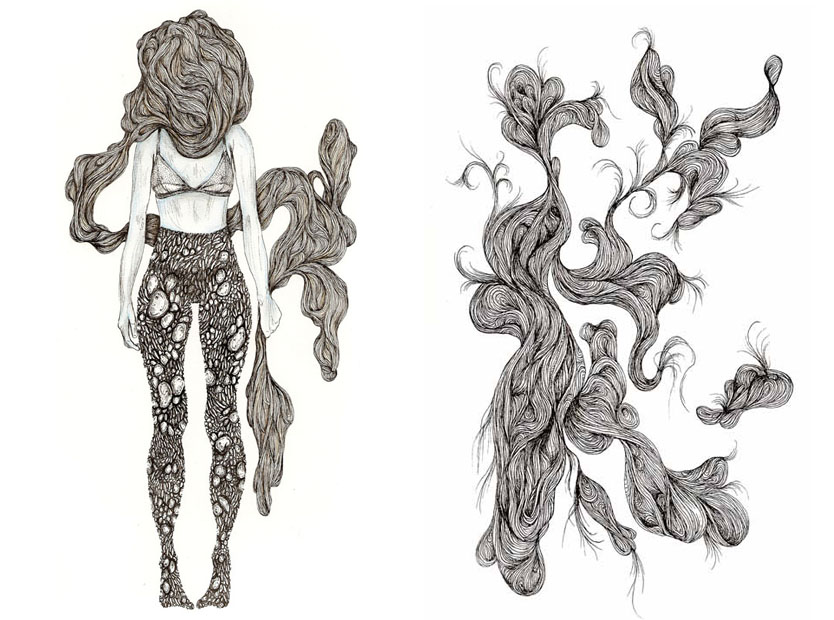
Justine Ashbee is an artist based in Seattle, WA and Brighton, UK.
All of her work is hand-drawn with paint pens. Her work consists of amorphous shapes which appear to resemble waves which seem to grow and morph into precise, delicate forms. 
Her work is entirely improvisational 
Artists comments on her work: "I’m utilizing stark, amorphous lines to trace the movement and human experience of the non-linear and imaginational realms. Through this intuitive visual language, a negotiation of the visceral and everyday human experiences of beauty and pleasure, and feeling are given voice."


I chose to look at Justine Ashbee's work as i found her style intriguing. I like the way that the abstract shapes show movement and look quite alive. 
I'd like to use this style as part of my contemporary print project as i like the line work and i think that it could be used to show textures and small details. 
I would think that this style would work quite well for close ups for the wood grain and patterns that i took pictures for. 


Drawing 'Journey' Project progress

For my journey project, i have been looking at continuous line drawings and different styles of drawing this way.
I'd like to add colour to these drawings otherwise, a larger piece could appear to be bland and monotonous. I want to do this by adding watercolour or ink to the drawing in blocks of colour to make focus points in each section.


Saturday, 4 January 2014

Artist: Paula Bonet

Paula Bonet is an illustration artist living in New York. She first started working by etching in oil paint until she realised that her technique took too long to complete.  She uses ink, pen and watercolour on wood or paper to create her work. She uses these materials as they are quick to use and fast drying materials which is necessary to meet the demands of her job. 
She illustrates for things such as magazines and posters for clients as far as Hong Kong and Mexico. 

The reason i chose to study Paula Bonet is because i admired her style, i like the sketchy lines and small blocks of colour. 
Personally, i prefer to draw things which don't take a lot of time and with small amounts of detail. 
I think that the use of little colour makes the work a lot more simple yet still effective, especially as poster or magazine illustrations. 
I really like this style and i'd like to take parts of the methods and materials and try them out for my own work. 


Artist:Naoko Ito

Pictures: http://artistaday.com/?p=5560

Naoko Ito is an installation and sculpture artist from Tokyo, Japan. She has a BA in science of design and graduated from Musashino Art University in Tokyo.
In her series titled 'Urban Nature,' she cut tree branches into small pieces and placed them into jars, assembling them into their original shape. 

The pieces show the way that nature is trapped and destroyed by man-made objects and controlled and contained. 
It also shows the fragility of nature and how easily it can be manipulated, especially by man.
I find the concept really interesting as it shows a lot of things about control and manipulation. As well as the more obvious meaning that nature is being trapped in the jars, this could also symbolise the way that people are trapped and controlled by society or by its own creations. The tree branch could represent an individual that wishes to grow as a person or find individuality and 'branch out' but is limited because of their surroundings.

Friday, 3 January 2014

Artist: Brett Manning, Drawing Presentation

Brett Manning is a drawing artist from Chicago. She is a current artist making new work constantly.


Brett's work is figurative with geometric shapes, patterns and symbols. 
Her work seems surreal but the subject of her works are more autobiographical and personal to the artist. She describes her work as 'glimpses into my head, untampered, abstaining from outside influences.' 
i think that this is a very interesting statement as i think that most art is created to break the barriers of the mind which are created by society and the views of 'right' and 'wrong.' I think that this is reflects in her work as it appears that her work, no matter how strange and abstract, is a glimpse into what goes on inside her head or daydreams that are untainted by reality. 
Her work is partly a visual diary which is based on her own emotions and things which are very sentimental. A lot of her backgrounds in her work are made up of thoughts or feelings, they create a dream-like feeling, especially her use of colour and objects.
Before working on her main pieces, she makes sketches and notes which she then accumulates into larger pieces. For my own work, i think this is relevant because i think that making small sketches and doodles can help influence larger pieces by gathering smaller idea's and developing small things into one greater idea. 
Her works which include items such as knitted jumpers or blankets show warmth and comfort. These works reflect her own insecurities and hiding herself away.

One of the main reasons i chose to include Brett Manning in my research is because i have been a fan of her earlier works for a while. In particular, i like the style which she draws hair and fabrics. 
Then i started to look into her more recent work which is more abstract and surreal. As you look around at all the small things that make up the drawing it creates a mood and almost tells a story.

Thursday, 19 December 2013

Artist: Nettie Wakefield

Group presentation on artist Nettie Wakefield
http://www.nettiewakefield.net/

Nettie Wakefield's works titled 'reversed portraits' are A3 sized pencil drawings of the backs of peoples heads. 
She is currently working on a masters degree specialising in drawing and she has been working independently on projects and exhibitions since 2009. She currently lives and works in London.
Her inspiration for the series came to her from sitting in a lecture theatre when she noticed the person in front of her had an interesting hairstyle. As she began to draw the back of her head she starting to consider who she was and what she looked like from the front. This series is aimed at provoking intrigue and curiosity from the viewer. 
The reason she chose to focus on the back of peoples heads is to discover how much information you can gather just by looking at somebody from behind. 
The reason i chose to look at Nettie Wakefield's work is because i found the concept of looking at something from a different prospective interesting. I like the way that her work is designed to make you think about how things which normally go unnoticed can still hold a lot of information about a persons personality, and in this case what they might look like from the front.
In relation to my own work, i really like how simple the subject is but it can stir thoughts in a viewer. I love the realistic style and how each individual hair is captured almost as if its moving. 
In the future, for my own work i'd like to find a simplistic subject which has a lot of meaning that makes the viewer want to know more information.


Wednesday, 18 December 2013

Inspirational Quotes

This quote is derived from Cesar A. Cruz's work titled 'To Comfort The Disturbed, and to Disturb the Comfortable: Onward children of the sun.' 
It is believed that Banksy is related to the quote above in relation to art.
I think that this is a very powerful sentence and i love the way it basically describes that art is something of an eye-opener to people that believe that they live in an 'ideal' world.
Personally i think that some of the best concepts are to show people and make them think about the things they normally turn a blind eye to.
I also think that the part about comforting the disturbed is very powerful as i think that using art at something to express ones own emotions is very effective. 
- Edgar Degas
This is another quote which is pretty relevant to the previous one. The message is mainly about opinion and about concept in an artists work. 
I think that art is showing a message, whether its societal issues, current issues or ongoing problems such as war, racism, sexism ect. 
It also related to the physical subject and how it may not be always aesthetically pleasing or it may be a magnificent art piece but it is essentially valueless as it doesn't have a clear message or mean anything to the viewer. 

Artist: Annette Messenger

While conducting research for the sculpture project i came across Annette Messenger. I also saw her work in the Tate Modern in London. Her work caught my eye as i like the way her work is in clusters and collections.
picture 
trendland.com

I like the way that her work is a collection of things which accumulate to one big piece. The context of her work usually relates to things happening in society such as feminism and culture. 
I like the idea of using a collection of objects to represent what you are trying to communicate and i'd like to do the same with my own sculpture work.
picturehttp://trendland.com/

Tuesday, 17 December 2013

Artist: Jonathan Yeo

Jonathan Yeo is an artist that i saw in the National Portrait Gallery in London.
Sienna Miller
Pictures from http://www.jonathanyeo.com


Jonathan's paintings vary in size and some are arranged in groups. His popular works are of recognisable people, actors, actresses and politicians. Some of his paintings are sized based on the popularity of his subject. 
The reason i chose to look at his work is because i find the way he focuses on the face of the subject and the rest of the painting is very out of focus and seems a little unfinished. 
picture (http://www.google.com/hostednews/getty/media/ALeqM5iw7yivRcnRibcwwG_SV_f4az0MvA)

Other the the style of his paintings, i like his use of colour. The backgrounds make his work seem very natural and almost make it look like the backdrop used in photography for school photographs. Collectively they look like variations of skin tones and pastels. 
Shebah 2013
picture http://www.jonathanyeo.com/gallery)
I particularly like this painting of the artists wife as the pose is very natural, it looks almost as though it was painted from life rather than a photograph. He has created this with his trademark 'unfinished' look which makes it a little more natural. I also like the way the colours are very neutral and light. 

Saturday, 14 December 2013

London Galleries

The concept behind this really intrigued me, the way that the piece shows that creativity and individuality is controlled and the lack of freedom of imagination. 
Tate gallery, London 
Jannis Kounellis, Untitled 1979
(picture www.tate.org.uk )

I felt inspired by this piece mainly because i liked the concept that everything which begins must have an end. Both the painting and the meaning are very simple yet it makes you think of things related to time and passage.
This has inspired me to take a similar concept with my print work. This could be related to decay and the way things fade into nothingness. I want to execute this by using ink in printing to show how things fade over use/time.
Lee Ufan, From Line. 1978
Picture (www.yiaos.com)

This painting created by shooting at pockets of paint under a layer of plaster, i like the way the marks are very uncontrolled and random.

Niki de saint Phalle, Shooting picture 1961


Wednesday, 13 November 2013

What is a studio?

Week 2. What is a studio?


  • Definition of a studio: 'an artists work room.' Studio derives from the latin work for 'study' or 'zeal' meaning diligence. 
  • A studio can be a place of solitude, somewhere to work without any distractions. 
  • A personal place to create work and not worry about mess in your home.
  • Somewhere to create and explore, to display older work and to work from it or to develop idea's. 
  • Benefits of working in a shared studio place such as university include being able to observe and learn from the work of others, to assist and be assisted by people around you and to socialise and share idea's.
  • Having your own personal space allows you the freedom to create whatever you want, the space is entirely for artwork, painting, sculpture, or drawing. 
  • There are negatives to sharing studio space is that there are most likely going to be distractions, other people to consider, less freedom of spreading out work and clearing up after working.

What is Art?

Week 1, What is art?


  • There is no definite definition for 'art.'  Anything can be considered art.
  • Art is a matter of opinion, something which makes the viewer think about what the message is. 
  • Art can be a message or a representation of current issues, the artists personal life or an emotion. 
  • Art raises questions, social views and may even change opinions about the subject. 
  • Art is something that is different in the 'eye of the beholder'
  • There is a huge change between the first works of traditional artists to the variety of modern art created today. Some may consider something only which is photo realistic or of a particular subject to be art. Today, art can be any media and any subject although a lot of art is heavily debated.
  • Art is a form of escapism to some, a break from every day life, to create an image of a utopia or even dystopia from the real world.
  • definition: the expression or application of human creative skill and imagination, typically in a visual form such as painting or sculpture, producing works to be appreciated primarily for their beauty or emotional power.